From Participation to Policy: MICAD contribution and lessons from the RECODE Policy Recommendation Workshop

How can research effectively shape public policy?
How can policy recommendations move beyond project deliverables to become real drivers of institutional change?
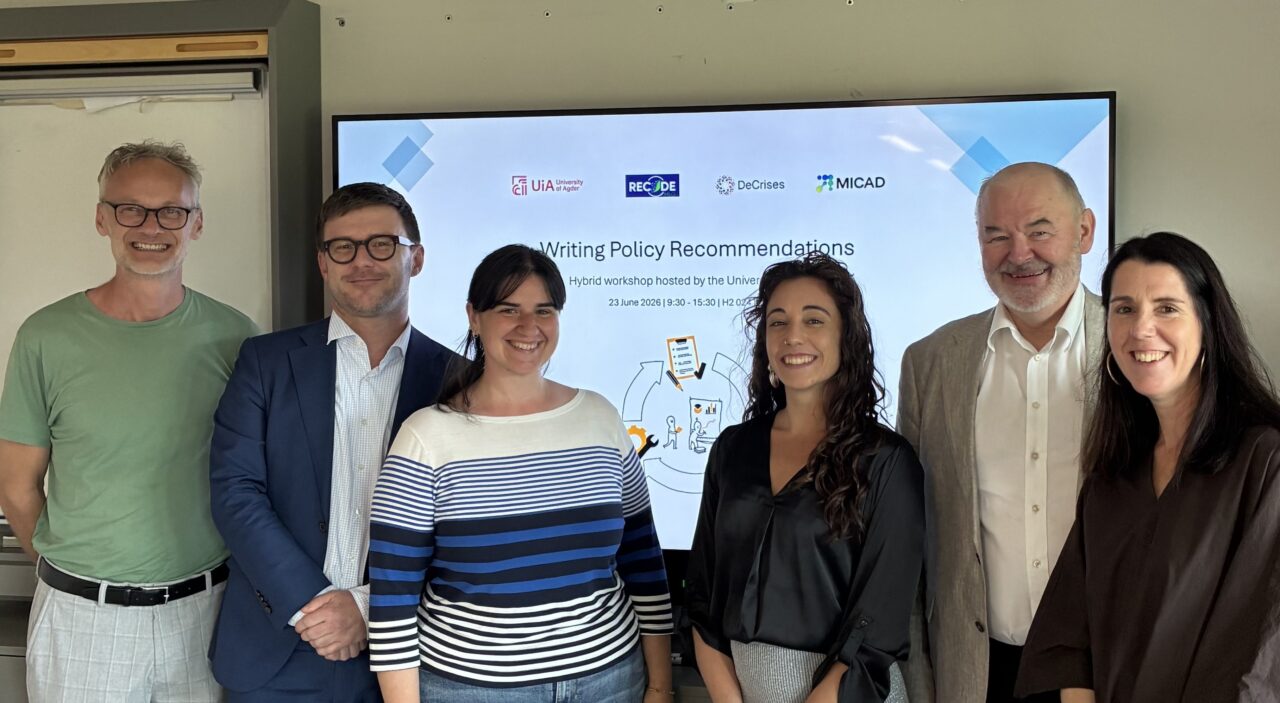
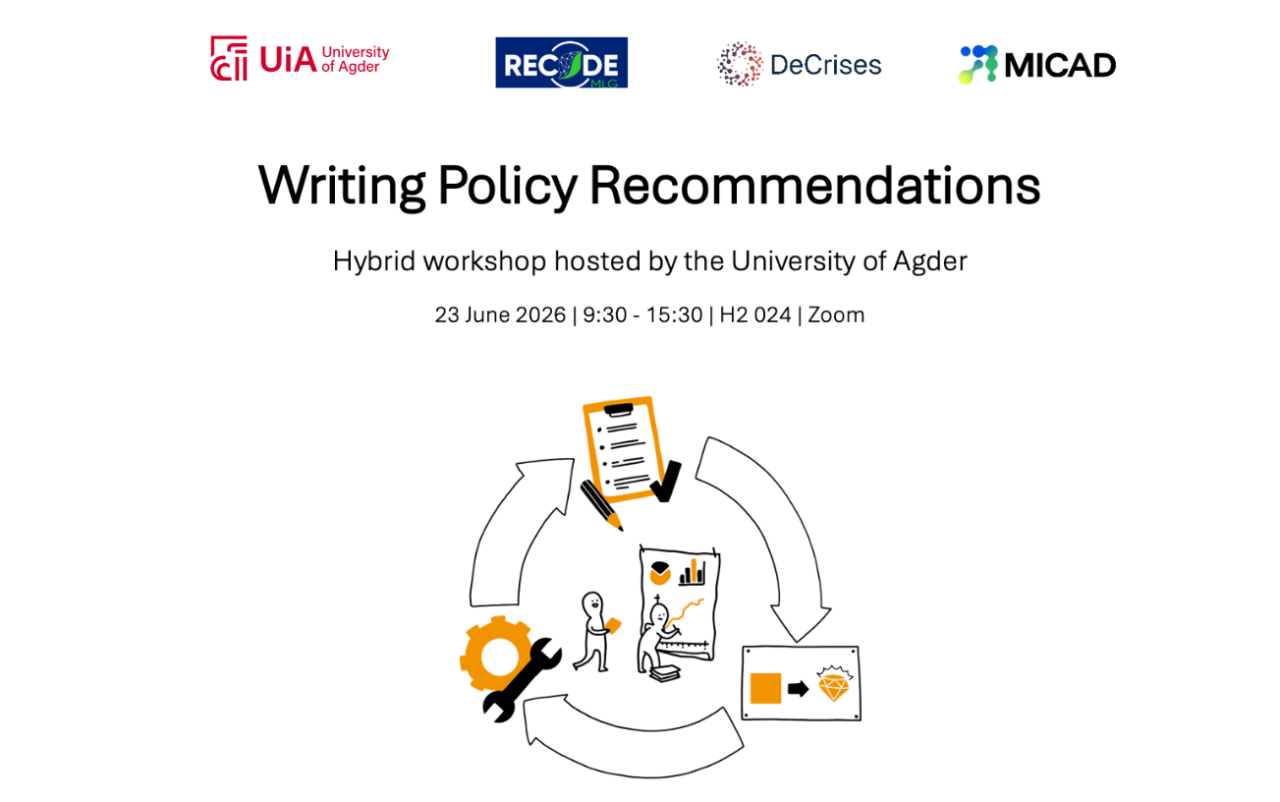
These questions were at the heart of the Policy Recommendation Workshop, titled “Writing Policy Recommendations: From Research to Impact” at the University of Agder in Kristiansand, Norway, hosted by the Sister Project RECODE MLG and moderated by Professor Amanda Margaret Machin and PhD Research Fellow Gloria Ziglioli from the University of Agder.
Bringing together researchers, public authorities and practitioners from across Europe, the workshop explored how scientific evidence can be translated into clear, actionable recommendations for policymakers.
As a sister project of RECODE, MICAD actively contributed to the discussion, sharing its experience in developing a participatory methodology for producing policy recommendations that are not only evidence-informed, but also grounded in stakeholder engagement and institutional realities.
Throughout the workshop, participants agreed on a common challenge: producing knowledge is no longer enough. Horizon Europe projects are increasingly expected to ensure that their research informs decision-making and contributes to tangible policy change. As stressed by Matúš Mišík, an Associate Professor at Comenius University and partner of the sister project DeCrises, researchers play a critical role in shaping public policy, particularly in today’s complex landscape, where misinformation can undermine informed decision-making.
Speakers highlighted several principles for effective policy recommendations. They should be concise, targeted to a clearly identified audience, supported by robust evidence and written in accessible language, as suggested by Professor John Erik Fossum from the University of Oslo. Recommendations should also acknowledge the political and institutional context in which they are expected to be implemented, recognising that evidence alone does not automatically translate into policy action, as underlined by Rebecca Marconi, ALDA’s project Manager and MICAD’s partner.
Jon Halvard Eide, an International Adviser at Agder County, stated that successful policy influence depends not only on the quality of the research but on the ability to communicate findings, build relationships with decision-makers and identify the right moments to engage with ongoing policy processes and existing institutional frameworks.
Representing MICAD, Rebecca Marconi presented MICAD’s methodology for developing policy recommendations, offering a complementary perspective to the more traditional understanding of policy briefs.
Rather than viewing policy recommendations as the final output of a research project, Rebecca argued that they should be understood as the result of a continuous process that accompanies the entire project lifecycle. According to MICAD’s approach, recommendations become more credible, legitimate and actionable when they are progressively developed through research, stakeholder engagement, testing and advocacy activities.
In MICAD this process is structured around four interconnected phases.
The first phase focuses on research and knowledge gathering, providing the evidence base through needs assessments, governance analyses and stakeholder consultations conducted across MICAD’s metropolitan pilot areas.
The second phase translates this knowledge into shared priorities through Living Labs and participatory co-design activities, ensuring that public authorities, civil society organisations and other stakeholders jointly identify the most relevant policy challenges and opportunities.
The third phase is dedicated to testing and validating the project’s tools and methodologies, strengthening institutional readiness for future implementation.
Finally, the fourth phase recognises that even well-designed recommendations require an effective advocacy strategy. This includes stakeholder mapping, strategic communication and the identification of policy windows where recommendations are most likely to influence decision-making processes.
As Rebecca emphasised during her presentation, policy recommendations should therefore be seen not as a one-off publication, but as part of a long-term dialogue with policymakers and continuous stakeholders’ engagement.
Another key message emerging from MICAD’s contribution concerned the relationship between participation and legitimacy.
While evidence remains fundamental, the workshop highlighted that policy recommendations become more robust when they are informed by the experiences and perspectives of the actors directly involved in policy implementation.
Drawing on MICAD’s experience, Rebecca explained how participatory processes help validate research findings, create shared ownership among stakeholders and strengthen the institutional capacity needed to implement future policy actions.
The discussion also addressed one of the recurring challenges faced by European projects: participation fatigue. Engaging stakeholders repeatedly throughout a project’s lifetime requires ensuring that collaboration generates tangible value for all participants and that engagement is based on genuine dialogue rather than one-way consultation.
The workshop concluded with a shared understanding that effective policy recommendations rely on more than technical expertise.
Researchers, practitioners and public authorities all have distinct but complementary roles in bridging the gap between scientific knowledge and public decision-making. High-quality evidence remains essential, but its impact depends on clear communication, collaborative governance and sustained engagement with policy actors.
MICAD’s contribution demonstrated how these elements can be integrated into a structured methodology that combines research, participation, capacity building and advocacy to support metropolitan authorities in addressing the challenges of the green and digital transitions.
Be part of a transformative movement towards inclusive climate and digital solutions. Together, we can shape sustainable metropolitan futures.
